Your customers aren’t making impulse purchases. Stop marketing to them like they are.
Are you selling Snickers Bars?
Because if you are, YouTube Shorts might be a brilliant marketing strategy.
Somebody’s hungry. They see chocolate, caramel, peanuts. They want a Snickers. They buy a Snickers. Everybody’s happy.
Nobody checks the chocolatier’s credentials.
Nobody requests references from the peanuts.
Nobody spends three weeks comparing candy bars before making a decision they’ll have to live with for the next twenty years.
Now imagine you’re a criminal defense attorney. Or a roofing contractor. Or somebody installing hardwood floors in a 120-year-old house.
Or anything more consequential than a candy bar.
If you’re selling something that requires trust, expertise, and a substantial financial commitment, why are you measuring success by how many strangers watched fifteen seconds of video?
I produce podcasts and YouTube content for lawyers, contractors, and nonprofits. I’ve spent a lot of time watching what happens after people click Play.
And I’ve got some numbers that make the Shorts obsession look pretty ridiculous.
Congratulations. You Got 100,000 Views. Did Anybody Give a Shit?
Across several YouTube channels I manage, I examined subscriber acquisition representing approximately 7,500 subscribers.
Shorts generated more total views than long-form videos.
Yet less than 1% of those subscribers came from Shorts.
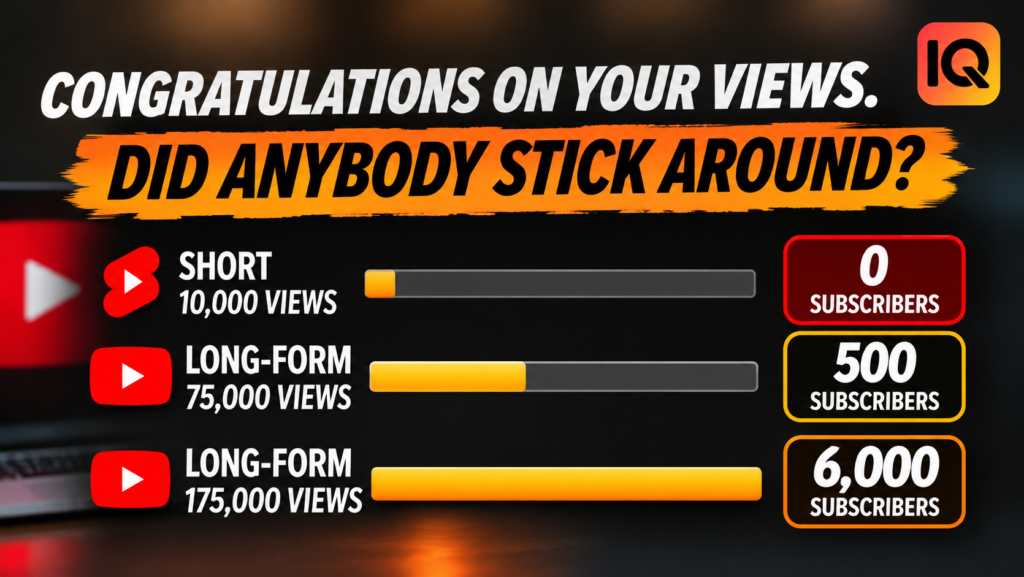
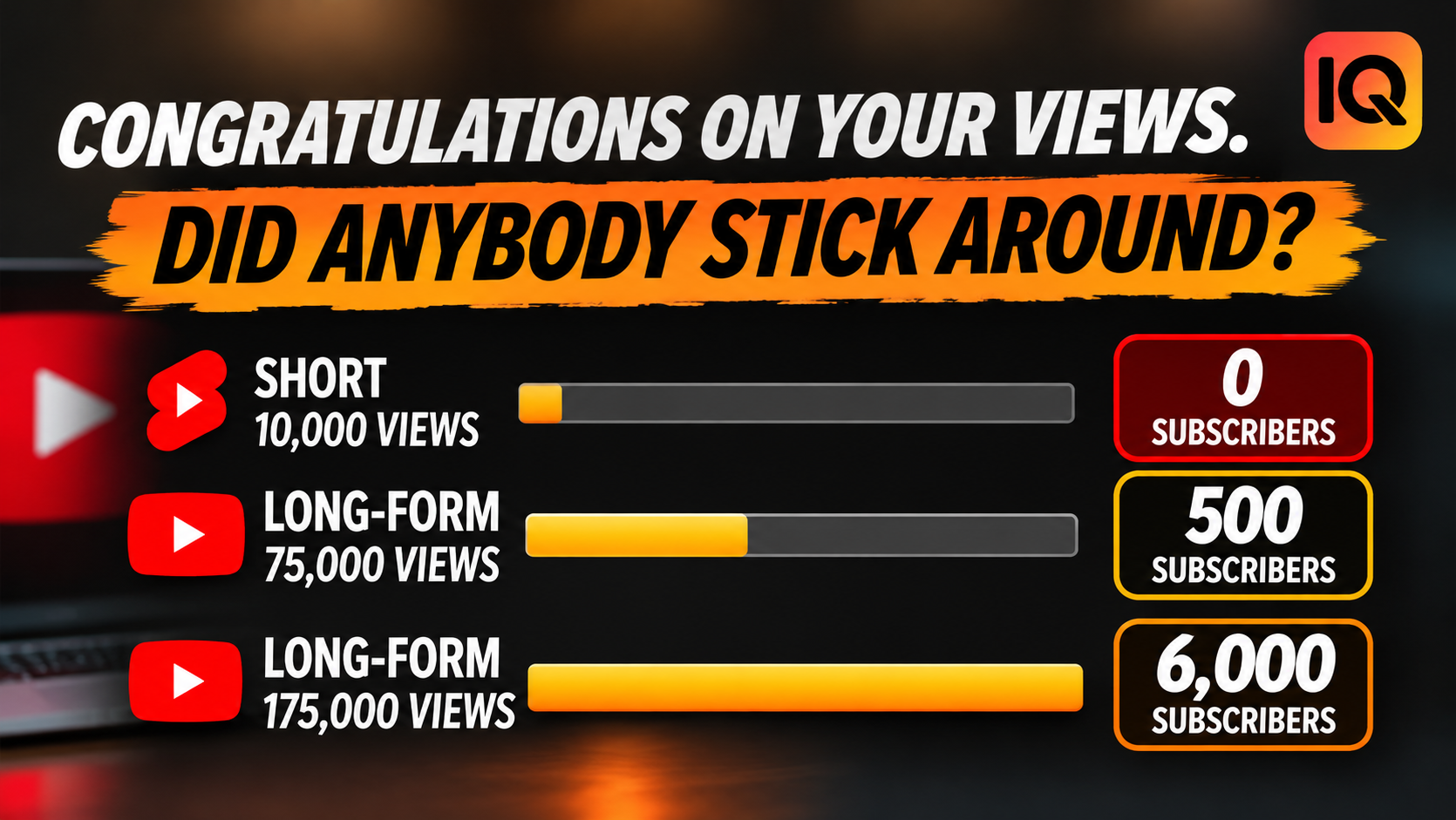
And then there’s this delightful little collection of actual video results:
| Video | Views | New Subscribers | Subscribers per 1,000 Views |
|---|
| Short | 10,000 | 0 | 0 |
| Long-form | 75,000 | 500 | 6.7 |
| Long-form | 175,000 | 6,000 | 34.3 |
The 175,000-view long-form video was a home run. Six thousand new subscribers.
The 75,000-view video? Still a solid double. Five hundred subscribers.
The Short delivered 10,000 views and precisely zero subscribers.
Ten thousand people showed up. Nobody wanted to stick around.
These are individual examples from my channels, not a controlled experiment. Other creators may get very different results. I’m not running their channels. I’m running mine.
Let’s Talk About What You’re Actually Selling
A $2 candy bar, a $7,000 floor, and criminal defense representation have very different customers.
| The Purchase | What’s Going Through Their Head | What Useful Content Can Do |
|---|
| Snickers Bar | That looks good. | Get noticed. |
$$$
Hardwood Refinishing | Will this contractor screw up my house? | Demonstrate methods and workmanship. |
$$$$
Roof | Will this roof protect my house? | Explain materials and installation. |
$?$?$
Criminal Defense | Can I trust this person with my future? | Demonstrate legal knowledge and judgment. |
Would You Hire a Criminal Defense Attorney Based on a Fifteen-Second Video?
Imagine you’re facing criminal charges in New Jersey. You’re scared. You’ve got questions. You need somebody who understands what happens in court.
One attorney has a Short with dramatic music, giant captions, and three things you MUST KNOW if you’ve been arrested.
Another has a substantial conversation with an experienced legal professional about an issue relevant to your situation.
You can hear the attorney explain the law, ask questions, respond to disagreement, and work through complicated issues.
Which one gives you more information about the lawyer?
That’s why I enjoy producing the Mighty MERP Podcast with New Jersey criminal defense attorney Melissa Rosenblum.
Melissa is a working trial attorney. Her conversations with other legal professionals provide opportunities to demonstrate what she knows without interrupting somebody’s scrolling session to yell legal tips at them.
For a lawyer, the expertise is the product. Why hide it behind fifteen seconds of entertainment?
Hardwood Refinishing: A Short Can Show It. A Conversation Can Explain It.
I’ve worked with hardwood flooring contractors discussing renovations in historic New Jersey homes.
A beautiful before-and-after video is terrific. People like beautiful floors. I like beautiful floors.
But a homeowner spending thousands of dollars might want answers to questions like these:
- Solid or engineered hardwood? Which is appropriate for the house?
- What’s under the existing floor? Does the subfloor need attention?
- What about moisture? How will conditions affect the installation?
- How is the floor installed? Which methods make sense for the project?
- Can it be refinished? What should the homeowner expect years from now?
That’s a conversation with somebody who knows what they’re doing.
And if I’m a homeowner deciding which contractor gets my money, I’d appreciate hearing those answers before anybody starts ripping up my house.
105 Views. Almost 60 Hours of Attention. Somebody Call the Algorithm Police.
I took existing podcast recordings and assembled three standalone YouTube compilations. No new interviews. No new recording sessions. Just previously recorded conversations edited into long videos.
And I mean long videos.
The Mighty MERP compilation averaged 39 minutes of viewing per engaged view. The NJ Criminal Podcast compilation averaged more than 35 minutes.
And Bridgeton Beacon, featuring South Jersey stories and history, averaged approximately 29 minutes.
Imagine telling somebody their video was a failure because it got 29 engaged views, while overlooking almost nineteen hours of accumulated watch time.
That doesn’t prove anybody became a client or donor. But it does tell me people were willing to spend serious time with the material.
Since When Is Fifteen Minutes of Somebody’s Attention a Failure?
I’ve heard people worry about an hour-long podcast because its average viewer watches only twelve or fifteen minutes.
Only?
Try stopping somebody on the sidewalk and explaining New Jersey criminal procedure for fifteen minutes.
See how that goes.
People listen during commutes, workouts, and household chores. They get interrupted. Sometimes they return. Sometimes they don’t.
But if somebody voluntarily spends fifteen minutes listening to a contractor explain a flooring installation, that contractor has had fifteen minutes to demonstrate expertise without delivering a sales pitch.
And Here’s the Part I Really Like: You Only Had to Record It Once
A single hour-long conversation can produce an extraordinary amount of material.
Take the hardwood flooring discussion. The contractor sits down once and talks about work they already know.
- Full-length YouTube video: The complete conversation.
- Audio podcast: For people who prefer listening.
- Transcript: The discussion preserved in searchable text.
- Focused articles: Solid versus engineered floors, subfloors, moisture, maintenance.
- Short clips: Individual answers and interesting moments.
- Future compilations: Related material from multiple conversations.
One recording session. Multiple outputs.
And the contractor gets back to installing floors instead of spending Tuesday afternoon inventing something to say to Instagram.
Yes, I produce Shorts. I cut clips. But the long-form recording is where I get the substance that makes those clips worth producing.
And Please, Stop Asking Me About YouTube Monetization
Lawyers ask me about YouTube monetization.
I find this hilarious.
You’re a criminal defense attorney. Your business is representing people charged with crimes. Why are you worried about how much YouTube might pay you for advertising?
Same goes for the contractor selling a $15,000 roof.
YouTube isn’t your customer. The person who needs a lawyer is.
Wouldn’t you rather your video helped somebody decide to call you about the work you actually do?
There’s an entirely separate discussion about Shorts monetization economics. But for businesses selling expensive services, it’s a ridiculous distraction from the actual business.