Google Maps Visibility Is About More Than Ranking for “Hotels Near Me”
At CLIQTS, everything starts and ends with Maps rank.
But a hotel’s Google Maps presence shouldn’t be evaluated through one generic keyword.
The property needs to understand how it appears across the entire landscape of relevant lodging searches.
Geographic Search Intent
Rowland, North Carolina, has an interesting geographic advantage.
The hotel isn’t simply competing for people specifically searching for Rowland.
It’s positioned along a major interstate corridor near a state border.
That means the relevant search territory can include nearby North Carolina and South Carolina communities, interstate exits, and travelers searching along their route.
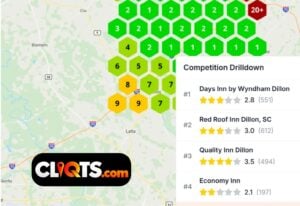
Google Maps rankings are geographically sensitive. A hotel can rank prominently for one search performed nearby and appear much farther down the results for the same search from another location.
A proper local visibility audit needs to account for that geography.
Amenity-Based Search Intent
A traveler looking for a kitchenette may be a different customer from someone looking for the cheapest overnight room.
A traveler seeking a quiet place to work may have different priorities from someone traveling with family.
The hotel should communicate its verified amenities consistently across its Google Business Profile, website, photographs, booking platforms, and other relevant business listings.
Google needs clear, consistent information about what the property actually offers.
So do travelers.
Immediate Booking Intent
Searches such as “hotel near me tonight” or “hotel near I-95” can represent immediate purchase intent.
For these customers, the hotel must make the decision easy.
Accurate contact information, useful room photographs, current reviews, clear amenities, and convenient directions all reduce friction between discovery and arrival.
Reviews Are Part of the Hotel’s Sales Process
Hotels are particularly interesting local search businesses because the customer often follows a very short decision-making process:
Search. Compare. Read reviews. Call or drive.
A property can have excellent accommodations and attentive ownership, but travelers who don’t know it exists cannot choose it.
And travelers who find it but encounter an incomplete or unconvincing Google Maps profile may keep scrolling.
This is where authentic customer experiences become extraordinarily valuable.
For example, a review describing the Rowland SureStay as clean, work-ready, well-lit, conveniently located, and family-operated communicates far more than a generic five-star rating.
It answers actual traveler questions.
Is the property clean?
Can I work from the room?
Is the Wi-Fi reliable?
Does the location make sense for my trip?
Will I feel comfortable arriving after dark?
Is someone paying attention to the property?
When real guests voluntarily describe their experiences in detail, future guests get information they can use.
Those reviews also help establish a credible public record of what makes the hotel distinctive.
Reviews are not a guaranteed shortcut to ranking for every keyword. But they are essential to the customer’s decision once the hotel appears in search results.
Family Ownership Is a Competitive Advantage Worth Communicating
Large hotel chains spend enormous amounts of money building brand recognition and customer trust.
An independently operated property has another potential advantage: visible, personal accountability.
At the Rowland SureStay, the attention to the property and its guests reflects the care associated with family ownership.
That story deserves to be communicated.
Not through generic marketing language about hospitality excellence, but through actual evidence.
Photographs showing the condition of the property.
Clear descriptions of its rooms and amenities.
Guest reviews that consistently mention cleanliness and attentive service.
Useful local information that helps travelers plan their stops.
A hotel can develop a recognizable identity even while operating under a national franchise brand.
And that identity can influence whether someone chooses it over another property a few exits away.
Local Content Can Turn a Highway Stop Into a Destination
There’s another advantage here that hotel operators frequently overlook.
The Rowland property is approximately 10 minutes from Q&J’s, a barbecue destination across the state line in South Carolina.
That may sound like a small detail.
But to a traveler spending the day on I-95, discovering a comfortable hotel near excellent local food can make an ordinary overnight stop much more appealing.
Useful content could answer questions such as:
-
Where should I stay near the North Carolina–South Carolina border on I-95?
-
Are there convenient hotels near good local barbecue?
-
Where can I find a work-friendly hotel along this stretch of I-95?
-
What amenities should I look for in a studio-style hotel room?
These topics can support genuinely helpful website content, relevant photographs, local recommendations, and a stronger understanding of the hotel’s geographic context.
They also create opportunities for the property to appear in traditional search results and AI-generated travel recommendations.
The goal isn’t to publish dozens of interchangeable articles.
It’s to create a useful, accurate body of information that makes the property easier to discover and easier to evaluate.
How CLIQTS Would Approach the Opportunity
For a hotel like this, we wouldn’t begin by recommending an expensive advertising campaign or a complete website redesign.
We would begin with the competitive landscape.
1. Establish the Hotel’s Current Maps Rank
Where does the property appear for the lodging searches that matter?
Not just directly outside its front door, but at relevant points along I-95 and within the surrounding travel corridor.
We’d examine the actual search results, identify competing properties, and establish a baseline.
2. Identify Search Categories the Hotel Can Credibly Own
Generic hotel searches matter, but they’re only part of the opportunity.
The property’s actual room configurations and amenities may create additional opportunities involving kitchenettes, work-friendly accommodations, studio-style rooms, and longer stays.
Every claim should be grounded in what the property genuinely offers.
3. Improve the Evidence Travelers See
The hotel’s Google Business Profile, website, photographs, amenities, and third-party listings should tell a consistent story.
Its strengths need to be obvious within seconds.
Travelers shouldn’t have to hunt for the information that makes the property attractive.
4. Build Authority Through Useful, Localized Content
A handful of well-developed articles, short videos, and authentic property features can create a substantial body of reusable marketing material.
One good conversation with the owners about the hotel, its guests, and its place along the I-95 corridor could produce a property feature, a video, short social clips, photographs, and supporting website content.
This is exactly the kind of authority-building media project that CLIQTS is designed to support.
5. Measure Calls, Directions, Bookings, and Visibility
Ranking improvements are useful only when they support business outcomes.
For a hotel, that means monitoring relevant Maps visibility alongside phone interactions, direction requests, website visits, and bookings where attribution is available.
A higher position in Maps is an opportunity.
More occupied rooms are the objective.
The Real Opportunity: Become the Obvious Choice Before the Traveler Reaches the Exit
The most interesting thing about the SureStay in Rowland isn’t that it sits near I-95.
Plenty of hotels do.
It’s that the property combines an extremely convenient location with practical accommodations, attentive family ownership, and characteristics that appeal to travelers who increasingly prefer studio-style lodging.
Those strengths already exist.
The opportunity is to make them visible.
A traveler familiar with Marriott’s StudioRes concept may not know this particular SureStay exists. Someone searching for a clean hotel near the state line may never think to search for Rowland by name.
But Google Maps can connect those travelers with a property that meets their needs.
That’s why we look beyond a business’s name and primary category when evaluating its local search potential.
Your competitors. Your territory. Your Google Maps visibility.
At CLIQTS, we identify where a business is positioned, how customers actually search, and what evidence can help make it the obvious choice.
For a family-owned hotel along one of America’s busiest interstate corridors, that can be a particularly compelling opportunity.
Because the next customer may already be driving toward the exit.
They just need to find you first.
About CLIQTS
CLIQTS helps locally operated businesses understand and improve their visibility in Google Maps and local search through competitive market intelligence, authority content, social activity, and practical media production.
Our approach begins with a simple question: Where does your business rank when customers are ready to call, visit, or buy?
cliqts.com